Australia Introduces New $1,500 Onshore Visa Surcharge: Who Must Pay, Exemptions and Everything You Need to Know
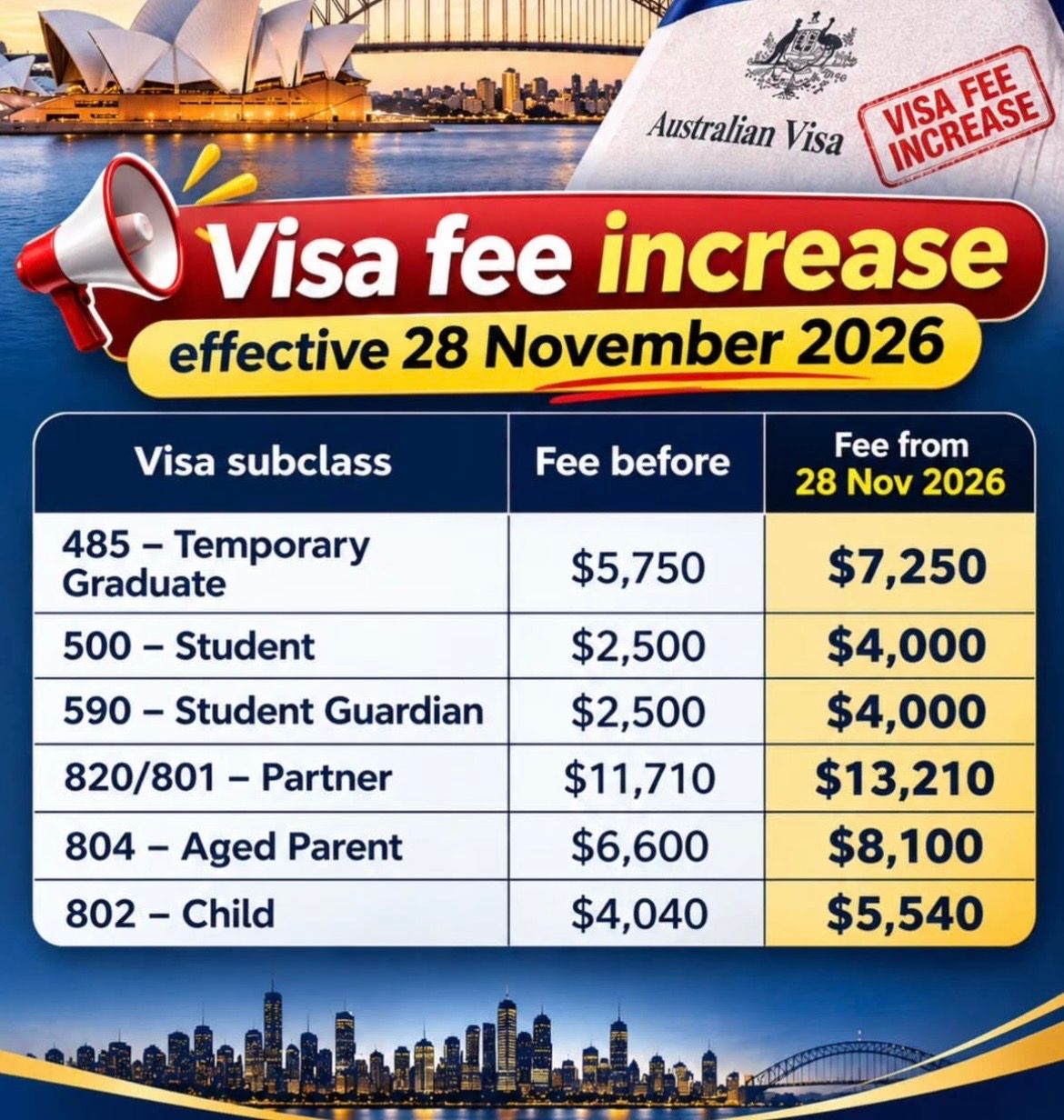
The Australian Government has introduced a new $1,500 Onshore Application Charge, significantly increasing visa application costs for international students, temporary graduates, partner visa applicants and certain migrant families.
The Australian Government has officially introduced an additional AUD $1,500 visa application charge for individuals applying for certain Australian visas while in the country.
The changes have been implemented under the Migration Amendment (Onshore Application Charge and Other Measures) Regulations 2026 (F2026L01607), registered on 27 November 2026.
The new charge came into effect on 28 November 2026 and forms part of the Government's broader migration reforms and 2026–27 Federal Budget measures.
What Is the New $1,500 Onshore Application Charge?
The Onshore Application Charge is an additional government fee imposed on eligible applicants applying for specified Australian visas.
The new charge is:
• AUD $1,500 per non-exempt applicant.
• Payable at the time of lodging a visa application.
• Additional to existing visa application fees.
• Applicable to eligible primary and secondary applicants.
• Applicable to eligible dependent children, including those under 18.
• Separate from the existing Subsequent Temporary Application Charge.
The charge has been introduced through new subregulations 2.12C(10) and 2.12C(11) of the Migration Regulations 1994.
It is not an annual fee or a charge imposed simply for holding an Australian visa.
When Does the New Visa Surcharge Come Into Effect?
The important dates associated with the new legislation are:
• 26 November 2026: Amendment regulations officially made.
• 27 November 2026: Legislation registered on the Federal Register of Legislation.
• 28 November 2026: New $1,500 Onshore Application Charge comes into effect.
The additional charge applies to relevant visa applications made on or after 28 November 2026.
Applicants who validly lodged their visa applications before this date are not retrospectively subject to the new charge.
Why Has the Australian Government Introduced the $1,500 Surcharge?
According to the Government's official explanatory statement, the additional charge supports Australia's broader migration reform agenda.
1. Reducing Net Overseas Migration
The Government aims to place downward pressure on Australia's Net Overseas Migration (NOM) through changes to migration policies and visa application arrangements.
Increasing the financial cost of applying for certain visas within Australia is intended to influence migration and visa application decisions.
2. Encouraging Offshore Visa Applications
The Government intends to encourage certain visa applicants to lodge their applications from outside Australia, where appropriate.
By introducing an additional financial cost for onshore applications, the Government aims to influence the choice between onshore and offshore migration pathways.
However, not all visa categories allow applicants to apply from overseas.
3. Generating Additional Government Revenue
The revenue generated through the new application charge will support the Government's broader migration system reforms.
The measure forms part of the visa charging changes associated with the 2026–27 Federal Budget.
4. Managing Australia's Migration System
The Government states that appropriate visa application charges can help manage visa demand, support investment in migration reforms and contribute to the long-term sustainability of Australia's migration program.
The actual impact of the measure on migration levels will depend on how applicants respond to the increased costs.
Which Australian Visas Are Affected?
The new $1,500 Onshore Application Charge applies to nine specified visa classes covering the following visa subclasses:
Student and Graduate Visas
• Subclass 500 – Student visa.
• Subclass 590 – Student Guardian visa.
• Subclass 485 – Temporary Graduate visa.
Partner and Child Visas
• Subclasses 820/801 – Onshore Partner visa application.
• Subclass 802 – Child visa.
• Subclass 837 – Orphan Relative visa.
• Subclass 445 – Dependent Child visa.
Parent Visas
• Subclass 804 – Aged Parent visa.
• Subclass 864 – Contributory Aged Parent visa.
• Subclass 884 – Contributory Aged Parent (Temporary) visa.
Other Family Visas
• Subclass 835 – Remaining Relative visa.
• Subclass 836 – Carer visa.
• Subclass 838 – Aged Dependent Relative visa.
The additional charge applies where applicants meet the legislative charging requirements and do not qualify for an exemption.
How Much Will Australian Visas Cost Now?
The introduction of the $1,500 charge increases the upfront application costs of several popular Australian visas.
Student Visa (Subclass 500)
• Previous standard application fee: $2,500.
• Additional onshore charge: $1,500.
• New standard onshore application fee: $4,000.
This represents a 60% increase in the standard application cost for affected Student visa applicants.
Student Guardian Visa (Subclass 590)
• Previous standard application fee: $2,500.
• Additional onshore charge: $1,500.
• New standard onshore application fee: $4,000.
Temporary Graduate Visa (Subclass 485)
• Previous standard application fee: $5,750.
• Additional onshore charge: $1,500.
• New standard onshore application fee: $7,250.
Onshore Partner Visa (Subclasses 820/801)
• Previous standard application fee: $11,710.
• Additional onshore charge: $1,500.
• New standard onshore application fee: $13,210.
Aged Parent Visa (Subclass 804)
• Previous standard application fee: $6,600.
• Additional onshore charge: $1,500.
• New standard onshore application fee: $8,100.
Child Visa (Subclass 802)
• Previous standard application fee: $4,040.
• Additional onshore charge: $1,500.
• New standard onshore application fee: $5,540.
All amounts are in Australian dollars and represent standard initial application charges for individual main applicants without concessions. Additional applicant charges, second instalments and other applicable fees may increase the total cost.
Does the $1,500 Surcharge Apply to Family Members?
Yes. One of the most significant aspects of the new legislation is that the additional charge applies per eligible applicant rather than per application.
This means spouses, partners and dependent children may each be required to pay an additional $1,500.
The additional financial impact could be:
• Individual applicant: $1,500 extra.
• Couple: $3,000 extra.
• Family of three: $4,500 extra.
• Family of four: $6,000 extra.
• Family of five: $7,500 extra.
• Family of six: $9,000 extra.
These charges are payable in addition to the existing visa application fees for each applicable family member.
What If Your Family Members Are Outside Australia?
Family members living overseas may still be subject to the additional charge.
Under the new regulations, secondary applicants included in a combined visa application can be liable for the charge if either they or the primary applicant is physically present in Australia when their application is made.
For example, an international graduate applying for a Subclass 485 visa in Australia with a spouse and child included from overseas could still be required to pay three separate onshore application charges, unless an exemption applies.
The family's additional cost would be $4,500, even though two applicants are physically outside Australia.
Major Financial Impact on Temporary Graduate Visa Applicants
The Subclass 485 Temporary Graduate visa is particularly affected because primary applicants must be physically present in Australia when lodging their applications.
Unlike certain other visa categories, international graduates cannot simply lodge their primary Subclass 485 visa application overseas to avoid the new charge.
For most primary applicants, the standard application fee has increased from $5,750 to $7,250.
Example: Subclass 485 Visa Application for a Family of Three
Primary applicant:
• Existing application fee: $5,750.
• Additional onshore charge: $1,500.
• Total: $7,250.
Spouse or partner:
• Existing additional applicant fee: $2,875.
• Additional onshore charge: $1,500.
• Total: $4,375.
Dependent child under 18:
• Existing additional applicant fee: $1,450.
• Additional onshore charge: $1,500.
• Total: $2,950.
Total family application cost before the surcharge: $10,075.
Total family application cost after the surcharge: $14,575.
Additional financial burden: $4,500.
These illustrative figures exclude health examinations, police clearances, English language tests, health insurance and professional migration assistance.
The Government's explanatory statement acknowledges that primary Temporary Graduate visa applicants must apply onshore but highlights that the visa provides graduates with unrestricted work rights and opportunities to develop their careers.
Who Is Exempt From the New $1,500 Charge?
The Australian Government has introduced exemptions for certain categories of visa applicants.
1. Eligible Pacific Regional Passport Holders
Certain applicants holding valid passports from specified Pacific regional countries qualify for exemptions under the relevant visa charging arrangements.
Eligible applicants, including those covered by relevant arrangements for Timor-Leste, will continue to benefit from existing concessional charging provisions.
Applicants must satisfy the specific exemption requirements applicable to their visa category.
2. Eligible ASEAN Student Visa Applicants
Certain Subclass 500 Student visa applicants holding valid passports from eligible Association of Southeast Asian Nations (ASEAN) countries are exempt from the additional charge.
These include eligible passport holders from:
• Brunei.
• Cambodia.
• Indonesia.
• Laos.
• Malaysia.
• Myanmar.
• Philippines.
• Singapore.
• Thailand.
• Vietnam.
The ASEAN concession specifically relates to eligible Subclass 500 applications and does not automatically extend to other visa categories, including Subclass 485.
3. English Language Course Students
Eligible Subclass 500 applicants enrolled in English Language Intensive Courses for Overseas Students (ELICOS) are exempt under the applicable charging provisions.
4. Non-Award Course Students
Eligible international students enrolled in non-award courses may also be exempt from the additional charge.
5. Other Specified Applicants
Certain visa applicants covered by special charging arrangements are also excluded from the new surcharge.
Applicants should carefully review the applicable exemptions before assuming they are eligible for a reduced application fee.
Does the Surcharge Apply to Indian, Nepalese and Other International Students?
International students from countries such as India, Nepal, Pakistan, Bangladesh, Sri Lanka and China are not covered by the general Pacific regional or ASEAN nationality-based concessions.
Applicants from these countries will generally be required to pay the additional $1,500 when applying for an affected visa onshore, unless they qualify for another exemption.
For most standard individual Student visa applicants:
• Applying from outside Australia: $2,500.
• Applying from within Australia: $4,000.
• Additional onshore cost: $1,500.
Applicants must also satisfy all relevant visa eligibility requirements, including restrictions on applying for a Student visa while in Australia.
Which Australian Visas Are Not Affected?
The new $1,500 Onshore Application Charge does not apply to every Australian visa category.
Popular visa subclasses not listed under the new charging provisions include:
• Subclass 189 – Skilled Independent visa.
• Subclass 190 – Skilled Nominated visa.
• Subclass 491 – Skilled Work Regional (Provisional) visa.
• Subclass 482 – Skills in Demand visa.
• Subclass 186 – Employer Nomination Scheme visa.
• Subclass 494 – Skilled Employer Sponsored Regional visa.
• Subclass 191 – Permanent Residence (Skilled Regional) visa.
• Subclass 600 – Visitor visa.
• Subclass 407 – Training visa.
• Subclass 417 – Working Holiday visa.
• Subclass 462 – Work and Holiday visa.
• Subclasses 309/100 – Offshore Partner visas.
• Bridging visas.
Existing visa application fees and other applicable charges continue to apply to these visa categories.
Can Applicants Leave Australia to Avoid Paying the $1,500 Surcharge?
This depends on the visa subclass and the applicant's individual circumstances.
Certain visa categories allow applications to be lodged from overseas. However, other visas require primary applicants to be physically present in Australia when submitting their applications.
For example, primary Subclass 485 visa applicants cannot avoid the additional charge by lodging their applications overseas.
Before considering offshore lodgement, applicants should carefully assess:
• Visa application location requirements.
• Current visa conditions and expiry dates.
• Bridging visa arrangements.
• Eligibility to return to Australia.
• Family members' locations and visa eligibility.
• Applicable exemptions.
Leaving Australia solely to avoid the additional charge without understanding the relevant immigration requirements could affect an applicant's eligibility or ability to return.
Is the $1,500 Charge the Same as the Subsequent Temporary Application Charge?
No. The new Onshore Application Charge and the existing $700 Subsequent Temporary Application Charge are separate components of Australia's visa charging system.
Some applicants may be required to pay both charges, depending on their visa history and application circumstances.
For example, an individual applying for a Student visa who is liable for both charges could pay:
• Standard Student visa application fee: $2,500.
• Onshore Application Charge: $1,500.
• Subsequent Temporary Application Charge: $700.
Total potential application fee: $4,700.
The $1,500 surcharge does not replace existing visa application fees or other applicable charges.
Does the New Charge Change Visa Eligibility Requirements?
The new surcharge changes the amount payable when lodging an affected visa application.
According to the Government's explanatory statement, this particular legislative amendment does not change visa eligibility requirements, visa decision-making criteria or access to merits review where available.
Paying the additional $1,500 does not guarantee that a visa application will be approved.
Applicants must continue to satisfy all applicable visa requirements.
Additional Change to the Humanitarian Visa Fee
The same legislative instrument also introduces a separate amendment affecting the Global Special Humanitarian visa (Subclass 202).
The relevant base application charge has increased from $570 to $580.
According to the explanatory statement, this amendment corrects an administrative oversight associated with annual visa fee indexation implemented in July 2026.
This is a separate adjustment and does not mean that humanitarian visa applicants are subject to the new $1,500 surcharge.
What Does This Mean for International Students and Migrant Families?
The introduction of the new Onshore Application Charge represents another increase in the financial cost of pursuing education, employment and family migration pathways in Australia.
International students planning to extend their studies, graduates transitioning to temporary work visas and families seeking to remain together in Australia may need to reconsider their financial commitments.
While the Government intends to manage migration levels and encourage offshore applications where appropriate, applicants for visas requiring onshore lodgement have limited alternatives.
The per-person nature of the charge means migrant families with dependent children could experience substantial increases in their overall visa expenses.
What Should Visa Applicants Do Now?
Before lodging an Australian visa application, applicants are encouraged to:
• Confirm whether their intended visa subclass is affected.
• Check whether they qualify for an exemption.
• Calculate the total application cost for all family members.
• Review their current visa conditions and expiry dates.
• Confirm whether offshore lodgement is legally permitted.
• Use the Department of Home Affairs Visa Pricing Estimator.
• Seek professional migration advice where necessary.
With the additional charge already in effect, financial planning is particularly important for international students, temporary visa holders and migrant families preparing to lodge their visa applications.
Effective from: 28 November 2026.
Stay connected with 24X Pulse for the latest Australian migration news, international education updates, visa reforms, skilled migration opportunities and government policy developments.
Disclaimer: This article is provided for general informational purposes only and does not constitute legal or migration advice. Visa application charges and eligibility requirements are subject to change. Applicants should consult the Department of Home Affairs, a registered migration agent or an Australian legal practitioner for personalised advice.

By 24xPulse
Passionate journalist covering the latest stories at 24xPulse.
View all articles by By 24xPulse →Related Articles

Australia’s 491 Visa: How Family Sponsorship Can Give Skilled Migrants 15 Additional Points Towards PR

Australia Announces Major Working Holiday Visa Reforms: New Invitation System and 70,000 Visa Places

Changes to Student visa application rules (subclasses 500 & 590)
More Stories

Coalition Promises $1.7 Billion Hybrid Train Fleet for Melbourne’s West
The Victorian Coalition has pledged $1.7 billion for 25 hybrid diesel-electric trains on the Melton and Wyndham Vale lines if elected in November. The plan targets higher-capacity services by 2030 while Melbourne’s west continues to wait for full electrification.

Telangana Horror: Man Accused in POCSO Case Allegedly Murders Six People After Getting Bail
According to police, the accused, identified as Rajkumar, was booked under the POCSO Act in May after a complaint was lodged by a 16-year-old girl and her mother, accusing him of sexual harassment and stalking. He later obtained anticipatory bail from a local court and was released on a personal bond, as the alleged offence carried a maximum punishment of less than seven years.

Shabad Six Murders and Rape Case: Police Launch Massive Hunt as Chilling Details Emerge
Shocking new details have emerged in the horrific Shabad six murders and rape case, with investigators revealing that the brutal crime spree unfolded over a span of nearly two hours.
Join the Conversation